
Bird Bingo: The Great Horned Owl
Bird Bingo for Bird Nerds!
Welcome to Bird Bingo! A new series where I basically vomit bird facts about whichever bird has crossed my path, and while trying to convince you to join along on the adventure.
The Bird Nerd Expectations:
You may expect a new bird bingo card about every tenth story.
(I post a blog story every Sunday, so every tenth week or so a new bird story and art piece for the collection).
Each bird bingo story will focus on one bird with an image, breakdown of basic and unique facts, and a personal story and/or my connection to the bird focused on.
I may also concoct a particular lesson to be learned from the focused bird, similar to my "lessons of the..." series, or I may just add some extra photos I enjoyed :)
The goal is to learn more about the birds of my area, to encourage you to learn and explore the outdoors and the creatures near you, and to potentially create a bird bingo art cards collection available to you all in my digital art shop.
Big goals, I know, but I believe we can do it and have fun along the way. So, with that said, let's dive in and get our bird nerd on!
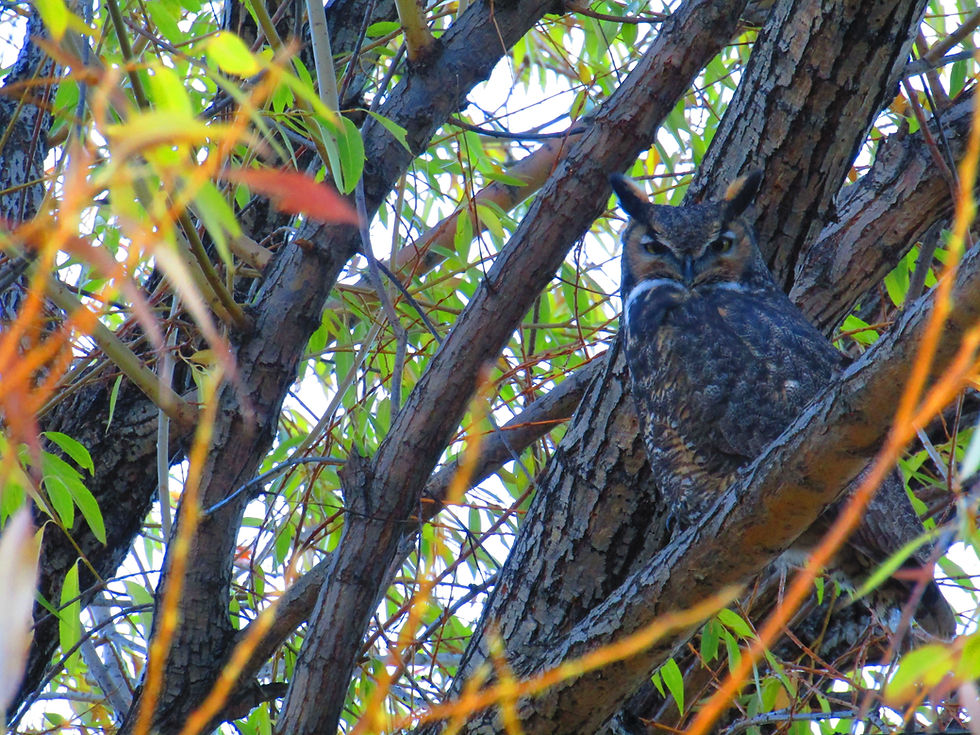
The Great Horned Owl [Bubo Virginianus]
Order: Strigiformes Families: Strigidae
You may recognize this bird as a beloved book character from the Hundred Acre Woods: a wise, and often a bit egotistical, teacher to Pooh and his friends in their many adventures. I grew up treasuring such classics, yet I've found a greater connection to this species from my own backyard...

Appearance:
Known as the "Cat Owl" with their characteristically large, ear-like tuffs & eyes. "Twice the size of the crows that often harass it. Color pattern similar to the smaller slimmer Long-eared Owl's; Horned Owl's ear tufts are larger & farther apart; its belly is finely barred horizontally, whereas the Long-eared is more boldly streaked lengthwise." ~ Golden
Location:
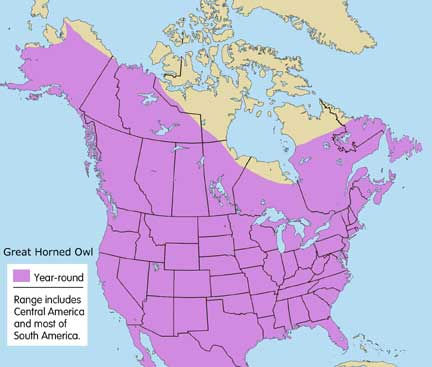
"Arctic to Strait of Magellan. West: Resident from Yukon drainage in Alaska & tree limit in Mackenzie South throughout West." ~ Peterson
Commonly found across the North Americas from Alaska to the Northern part of Mexico (covering the entire [landlocked] USA).

Habitat:
Forests, woodlands, thickets, stream sides, open country, deserts, canyons, & cliffs.
I live by the riverside surrounded by Cottonwood trees, Willow thickets/bramble hedges, & old Willow trees. These owls tend to always return to this Willow tree, favoring the habitat & perhaps the history of this ancient tree.
Nests:
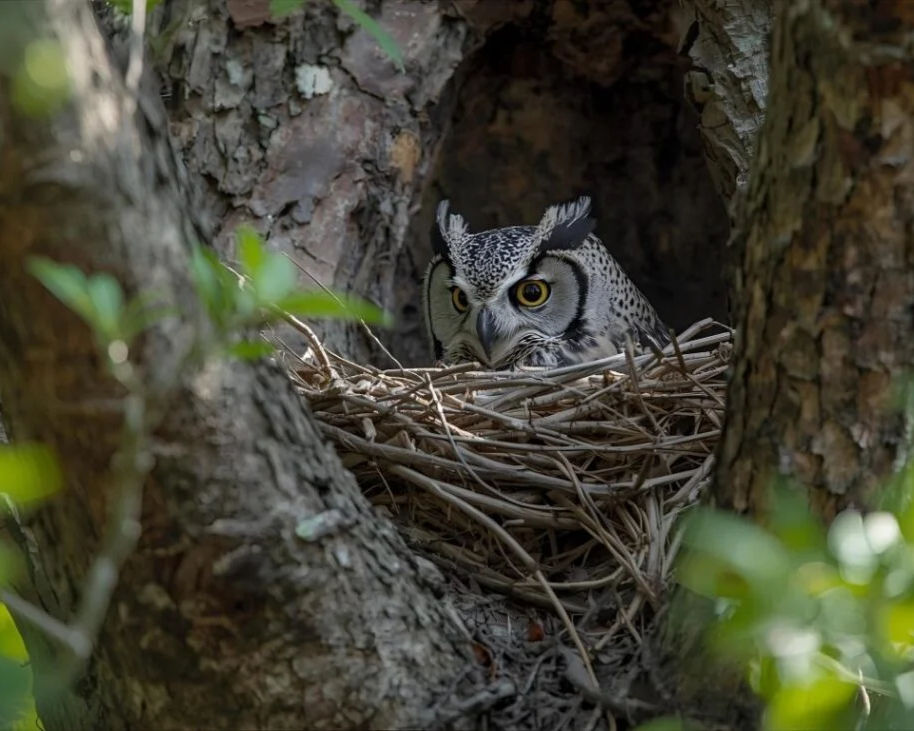
Prefer old nests of herons or hawks in trees, potholes, cliffs, or river bluffs (sometimes even on the ground); commonly known as cavity nesters. Clutch of 2-3 white eggs.
Call / Song:
"A resonant hooting of 3-8 hoots: males usually 4-5, in this rhythm: hoo, hoo-oo, hoo, hoo; Females (lower in pitch) 6-8: hoo, hoo-hoo-hoo, hoo-oo, hoo-oo." ~ Peterson

Flight:
Dark figure; comparable to largest hawks. Nearly, to completely, silent in flight due to the design of their feathers. In flight, their wings could be distinguished by their more rounded appearance when compared to hawks.
Diet:
Typically hunt for rodents, reptiles, & other [small] mammals. Owls tend to swallow their prey whole, digesting the "edible materials" then discarding the rest through a pellet (in a similar concept to a cat spitting out a hair ball). People like to dissect such pellets to observe the bones & decipher the original animal figure, often a fun school science project.
Behavior:
Mostly nocturnal; most active & heard at dusk as they communicate amongst one another during their "stake out" searching for prey. As their eyes are fixed in place in their sockets, they are able to shift their entire head nearly 270 degrees (roughly three-quarters of a circle) in order to shift their gaze.
Fun Fact:
Although these owls have excellent eyesight, they do not rely on sight alone to hunt for prey; they also depend on sound. By design, such owls have off set [asymmetrical] ear canals, located behind their eyes, that allow them to have impeccable hearing, enabling them to pinpoint the exact location the sound came from. Their facial disc essentially acts as a "radar dish," picking up sound vibrations similarly to echolocation.
Environmental Impact & Population Stressors:
As a top predator in the Americas, the Great Horned Owl plays a crucial role in regulating rodent populations and maintaining ecological balance (i.e., preventing overgrazing, rapid spread of disease, and contributing to the balance of the food chain through species diversity). Considering their wide range of residence and diverse habitation, this species is considered as "least concern" (in conservation terms) with a stable population and a strong ability to adapt to diverse habitats. Although their population remains stable, owls also are quite sensitive to environmental changes, thus making good biomarkers to the health of ecosystems.
It may come as no surprise that the main threat to the Great Horned Owl populations and their habitats are humans. More and more habitat loss is attributed to clear cutting for agricultural sites and expanding towns/cities., destroying homes, nesting areas, and pushing out prey. Additionally, owls face threats from car collisions and traps set for other animals (often getting caught is such traps in pursuit of prey). Humans also cause stress to nesting owls, scaring them away from properly caring for their young or from their habitat altogether. Finally, the growing temperatures drastically change formerly habitable ecosystems for such species, driving out dietary prey and making some ecosystems too hot or dry from owls to find proper shelter or to hunt sufficiently.
Why Should We Care?
I don't believe this owl is technically considered as a keystone species; however, they play a pivotal role within the food chain and to ecosystems. Furthermore, being a bioindicator to the health of ecosystems, they enable us to understand the trajectory and to enable preventative/conservation measures before we hit the "point of no return." Essentially, if there's a posed threat against the Great Horned Owl species, then the whole ecosystem is facing a threat. Personally, I would prefer if our country was more preventative than reactive, meaning we should try to resolve issues and put practices in place to prevent further problems, rather than reacting when problems are often beyond repair. I suppose not everyone appreciates birds, or the Great Horned Owl in particular, but even so they would be a great loss many would feel without truly realizing. We've all known loss too well recently, and it may seem a small matter to others, but I wouldn't want to imagine a world without owls calling through the night outside my bedroom window.
...Every year come Autumn, a pair of feathered neighbors would return to the cul-de-sac, calling out into the night, 'hoo, hoo-oo, hoo, hoo' as a homecoming cry. And every year, I would look out for such friends in anticipation, often waiting the night away at the windowsill just to witness their longing conversation from different sides of the road (almost akin to a Romeo and Juliet rendition of raptors). Before long, it became my own tradition to tread across the neighborhood, seeking out the couple hiding away in the old Willow or Cottonwood tree, perfectly blended as one with the barked texture. Of course, they knew I was heading their way even before I closed the front door, despite my best efforts to tip toe over the crunchy bed of pine needles and dried grass, yet they had a rather impassive disposition to my presence; so long as I did not disturb them much, then they would oblige to posing for my camera, often with a rather disgruntled glare.
Only a few times did they grow impatient with this bumbling human hobbling below them, screeching their discontent at my presence quite clearly. Leaping from the canopy, they would glide over my awe-struck head, soaring without a sound, practically becoming one with the wind: one [element] heard but unseen, the other [creature] seen but not heard; yet both with a powerful presence felt. Oh, how I tried to capture the moment, but alas I have deemed the task impossible, for how could I possible portray the wonderment of experiencing such a scene, of feeling such a presence? Every time, the air evades me, leaving me breathless as I marvel at such creatures, trying to imagine how it would feel to embody freedom so completely as they do. The wildness and wisdom deeply swirling within their gaze, the exhilaration of soaring above the world, the overwhelming pull to careen down towards the land in pursuit of the catch; the ancient, wild nature of raptors is truly alluring. One does not need to be attracted to birds or raptors to find themselves captivated by them when they've had the privilege to be in their company.
Beyond such fascination, I have felt another pull to the Great Horned Owl in particular over the years. As a writer with an expansive imagination, I cannot refrain myself from drawing a greater meaning or purpose from their reoccurring presence in my life. Being cyclical in their homecoming during the Autumn season, a time of transition in nature and for everyone in general, it seemed as if they were a sign: a sign of wisdom in and of themselves, but also of a grand journey ahead awaiting me. You see, dear reader, the owl pair would always seem to reappear in my life during big periods of transition, often when I'm drowning in bouts of the "unknown next." The more and more I would think of them, the more they would unexpectedly cross my path, until they inevitably slipped into my dreams. I remember in particular the Autumn I was to go off to university, the adventure I have been long waiting for, trudging through high school each day with this 'end goal' in constant mind. For whatever reason that year, the owls would perch upon either telephone post outside my home, calling long into the night, every night, for what seemed like forever. Even without searching for them, they would always find me out on my solo ventures trying to clear my mind and explore outdoors.
Well, I drew the conclusion that they must be here to tell me that I truly am about to experience a grand journey, that college will be everything I've imagined and more... That was the year of the global pandemic, the year I did catch the virus just as everyone did at one point or another, and the year where my health began to decline quite rapidly. And the dreams, oh the dreams didn't end. No, they would continue to visit me in the night throughout the seasons for years and in various visions. At one point, succumb with distain at the world for the unfairness of it all, I became besieged with loathing for the very creatures I used to fathom. They felt like a phantom haunting, taunting me of my unlucky disposition in life. In truth, I was wallowing, or more so grieving; grieving the person who I once was, and who I could have been. I was grieving the life taken from me as I was still breathing, and at that time I simply needed someone to blame. Of course, no one is to blame, not really, and after a while my perspective changed. Perhaps my long-beloved neighbors were not haunting me, but maybe they came as a warning; a warning of the world, my world to come for indeed it has been a grand journey after all (although unexpected and riddled with twists and turns). And perhaps they kept coming into my dreams, watching me back in wonder: "what are you going to do now, with this life you have been given?" My past may not have been of my design, but it is my responsibility of what I do with it. Now I know, one should never question the wisdom of the Great Horned Owl, and I continue to ponder the teachings they bring to me upon their return each Autumn.
I suppose it reasonable to assume I have the Great Horned Owl to thank for being the catalyst to my growing interest in birds, and for being an anticipated neighbor each year. I hope you found this article intriguing, that you had the opportunity to learn something, or simply enjoyed my personal story and connection to these raptors. I hope to write more Bird Bingo articles soon, and I may even create an art collection inspired by this series (please, let me know if you are interested and/or if you have any recommendations for more content you would want from me). As always, thank you for being here, I hope you have a wonderful spring season and that you find the luck to cross paths with an owl yourself. Until next time,
Resources:
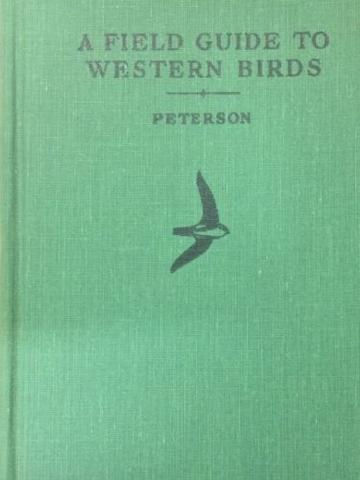
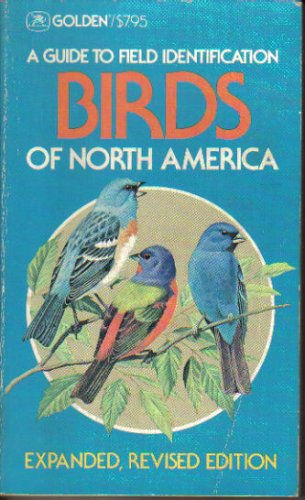
These two books are my treasured finds I am still slowly exploring that I used for some of the general information in this article but use often for quick bird identification. I also enjoy another book focused on songbirds in particular, which I love to take with me while traveling around the country to learn and identify new birds in different areas. Otherwise, all additional information I collected from the deep sea of the world wide web. If you would like your own copy of these books, then I've included the links below for quick reference (and by clicking the links I appreciate your support, every click counts :).


Comments